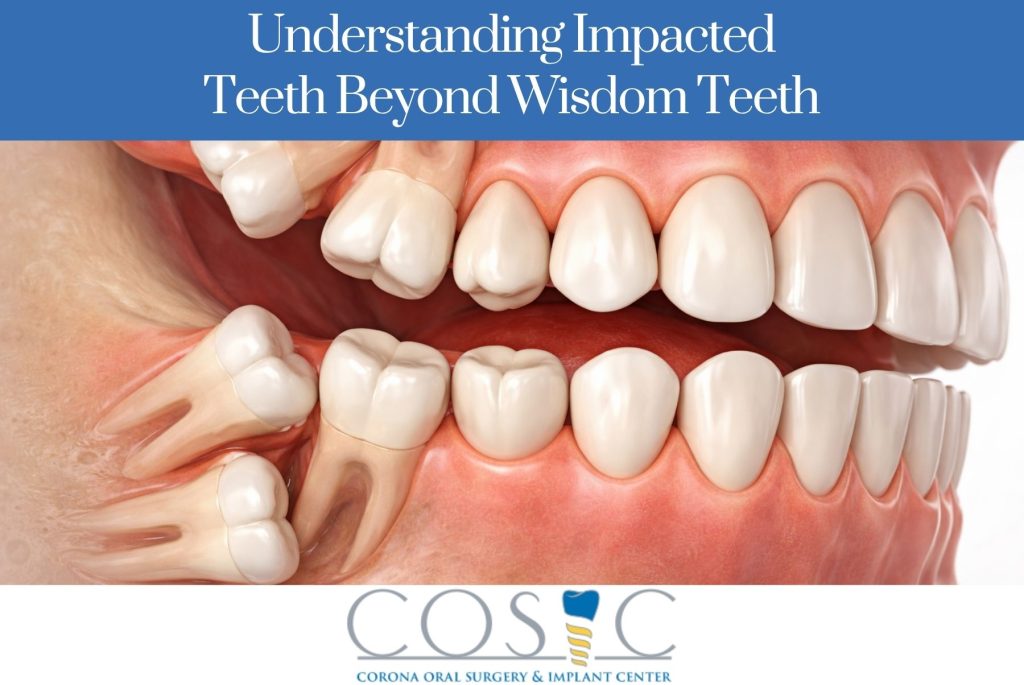
When most people hear the term “impacted teeth,” they immediately think of wisdom teeth. While wisdom teeth are the most commonly impacted, they’re far from the only ones. At Corona Oral Surgery and Implant Center, patients are often surprised to learn that other teeth—especially canines and premolars—can also become impacted, leading to a range of oral health issues if left untreated.
This comprehensive guide will help you understand what impacted teeth are, why they occur, how they’re treated, and why timely care is essential for protecting your long-term dental health.
What Is an Impacted Tooth?
An impacted tooth is one that fails to fully emerge through the gums into its proper position in the dental arch. This can happen when there isn’t enough space in the mouth or when something physically blocks the tooth’s path.
Impacted teeth may:
- Remain completely hidden beneath the gums
- Partially emerge, creating a risk for infection
- Grow at an angle, pressing against neighboring teeth
Teeth Commonly Affected Beyond Wisdom Teeth
While third molars (wisdom teeth) are the most well-known, several other teeth are frequently impacted:
1. Maxillary Canines (Upper Eyeteeth)
These are the second most commonly impacted teeth after wisdom teeth. They play a crucial role in:
- Proper bite alignment
- Facial aesthetics
- Guiding other teeth into position
2. Premolars (Bicuspids)
Premolars can become impacted due to crowding or early loss of baby teeth, disrupting normal eruption patterns.
3. Incisors
Though less common, front teeth can also become impacted—often due to trauma or developmental issues—affecting appearance and function.
Causes of Impacted Teeth
Impaction doesn’t happen randomly. Several underlying factors contribute to it:
- Overcrowding: Not enough room in the jaw for all teeth
- Genetics: Family history of impaction or small jaw size
- Abnormal tooth positioning: Teeth growing at unusual angles
- Retained baby teeth: Preventing adult teeth from erupting
- Cysts or tumors: Rare, but can block tooth eruption
Symptoms of Impacted Teeth
Some impacted teeth remain asymptomatic, but many present noticeable signs, including:
- Pain or tenderness in the gums or jaw
- Swelling or redness
- Difficulty opening the mouth
- Bad breath or unpleasant taste
- Shifting or crowding of nearby teeth
In some cases, impacted teeth are only discovered through routine dental X-rays.
Why Treatment Matters
Ignoring an impacted tooth can lead to serious complications:
- Infection or abscess formation
- Damage to adjacent teeth
- Cyst development
- Gum disease
- Misalignment of teeth
Early diagnosis and treatment can prevent these issues and preserve your oral health.
Treatment Options for Impacted Teeth
At Corona Oral Surgery and Implant Center, treatment is tailored to each patient’s unique needs.
1. Monitoring
If the tooth isn’t causing problems, your oral surgeon may recommend periodic observation.
2. Surgical Exposure
For teeth like impacted canines, a minor surgical procedure can expose the tooth and allow orthodontic guidance into position.
3. Extraction
If the tooth poses risks or cannot be properly aligned, removal may be the best option.
4. Orthodontic Treatment
Often used in conjunction with surgical exposure to guide impacted teeth into their correct position.
Advanced Care at Corona Oral Surgery and Implant Center
Patients benefit from:
- State-of-the-art imaging technology for precise diagnosis
- Minimally invasive surgical techniques
- Personalized treatment planning
- Experienced oral surgeons focused on comfort and outcomes
Comprehensive Q&A Section
Q1: Can teeth other than wisdom teeth really become impacted?
Yes. While wisdom teeth are the most common, canines, premolars, and even incisors can become impacted due to crowding, genetics, or developmental issues.
Q2: How do I know if I have an impacted tooth?
Some signs include pain, swelling, or crowding. However, many impacted teeth are only detected through dental X-rays during routine exams.
Q3: Are impacted canines serious?
Yes. Impacted canines can affect your bite, smile appearance, and overall dental alignment. Early treatment is often recommended.
Q4: Is treatment always necessary?
Not always. If the impacted tooth isn’t causing problems, monitoring may be sufficient. However, many cases require intervention to prevent complications.
Q5: Is surgery painful?
Modern oral surgery techniques and anesthesia options make procedures comfortable. Most patients report minimal discomfort during recovery.
Q6: How long is recovery after extraction?
Recovery typically takes a few days to a week, depending on the complexity of the procedure.
Q7: Can impacted teeth cause infections?
Yes. Partially erupted teeth can trap bacteria, leading to infections, swelling, and even abscesses.
Q8: Will insurance cover treatment?
Many dental insurance plans cover medically necessary procedures. It’s best to check with your provider or contact the office for assistance.
Q9: At what age should impacted teeth be evaluated?
Teen years are ideal, especially for canines. Early evaluation allows for more effective and less invasive treatment.
Q10: Why choose an oral surgeon for impacted teeth?
Oral surgeons have specialized training in surgical procedures, ensuring safer, more efficient treatment—especially for complex cases.
Schedule Your Consultation Today
If you suspect you may have an impacted tooth—or want a professional evaluation—early care can make all the difference. The expert team at Corona Oral Surgery and Implant Center is here to provide trusted, advanced care tailored to your needs.
Contact Information
Corona Oral Surgery and Implant Center
914 South Washburn Avenue Suite 3
Corona, CA 92882
📞 Phone: (951) 736-8133
🌐 Website: cosicdds.com